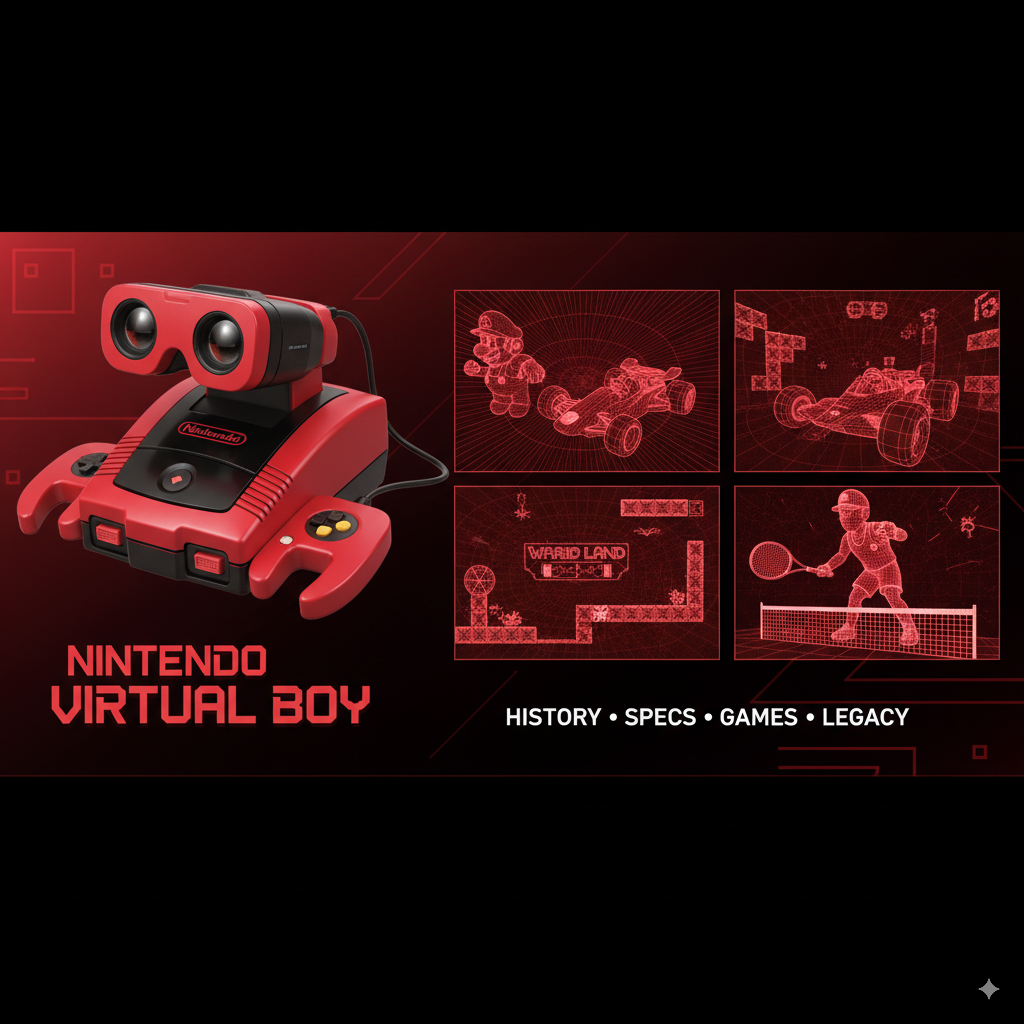
Virtual Boy — History, Specs, Games, and Why It Failed (Plus Collector’s Guide)
The Virtual Boy is Nintendo’s infamous 1995 attempt at a consumer VR console — a bold experiment that’s now a cult classic. It promised immersive 3D visuals, but limitations in hardware, ergonomics, and software library led to commercial failure. Today it’s a fascinating piece of gaming history and a sought-after collector’s item.
What was the Virtual Boy?
The Virtual Boy was a tabletop console developed by Nintendo and released in 1995. Rather than a headset you wear like modern VR, it used a vertical, visor-style display that the player peered into while seated. It produced stereoscopic red-and-black 3D images using oscillating LED arrays — one red LED per pixel per eye — delivering a primitive but convincing 3D effect for its time.
Key hardware specs & design
- Display: Two LED displays (one per eye), monochrome red on black, stereoscopic 3D
- Processor: 32-bit RISC CPU (ARM7-based in later documentation)
- Audio: Mono output via built-in speaker or headphone jack
- Controls: Dual D-pad–style controllers mounted on the unit (one for each hand)
- Form factor: Tabletop/visor design — you lean into the unit; not a wearable headset
- Media: Proprietary ROM cartridges
- Launch region & year: Japan and North America, 1995
The game library — highlights
The Virtual Boy’s library was small (about 22–30 official titles depending on region). Notable games include:
- Wario Land (Virtual Boy Wario Land) — the system’s best-known title and a must-play.
- Mario’s Tennis — decent sports title with fun multiplayer.
- Teleroboxer — a 3D boxing demo of the system’s potential.
- Red Alarm — a first-person shooter that showcased depth perception.
- Virtual Boy Wario Land and a few puzzle/platform experiences rounded out the catalog.
Because of the small library, lack of third-party support, and mixed quality, the system struggled to keep players engaged.
Why the Virtual Boy failed
Several factors contributed to the Virtual Boy’s commercial flop:
- Uncomfortable ergonomics: The machine required players to lean into a stationary visor — not portable or comfortable for long sessions.
- Monochrome display: Red-on-black visuals were chosen for technical reasons, but felt outdated and caused eye strain for many users.
- Health concerns: Reports of headaches, nausea, and eye strain discouraged widespread adoption.
- High price & poor positioning: Launched at a premium price and marketed ambiguously between a novelty and a core gaming platform.
- Small software library & limited third-party support: Developers didn’t commit, so there were few killer apps.
- Timing & competition: The market was shifting toward 3D-capable home consoles (PlayStation, Saturn) and handhelds (Game Boy) where Nintendo later focused.
Nintendo discontinued the Virtual Boy less than a year after launch — a rare and swift retreat for the company.
Legacy & influence
Although a commercial failure, Virtual Boy mattered:
- It was one of the earliest mass-market attempts to deliver stereoscopic 3D, influencing later VR research.
- It demonstrated both the potential and the pitfalls of consumer VR: immersion vs. ergonomics and health.
- Its rarity and novelty made it a collector’s favorite, boosting retro interest decades later.
Some design lessons from Virtual Boy informed later Nintendo hardware decisions — including how user comfort and content ecosystem are critical.
Collector’s guide: value & what to look for
Today, the Virtual Boy is a collectible. Prices vary by condition, rarity of games, and bundle contents.
What affects value:
- Complete in box (CIB) systems fetch much more than loose units.
- Popular/rare titles (e.g., Japan-only releases, boxed Wario Land) increase value.
- Working units with good cosmetic condition are preferred.
- Official accessories and manuals boost price.
Where collectors buy (USA):
- eBay (watch seller ratings & item condition)
- Retro gaming stores and conventions
- Facebook Marketplace and local classifieds (good for avoiding shipping damage)
- Specialist retro retailers (often pricier but more reliable)
Buying tips:
- Ask for recent photos of the actual item and proof it powers on.
- Check for common issues: dead LEDs, cracked plastics, brittle power connectors.
- If collecting for display, CIB might be worth the premium; for playing, a clean working unit is ideal.
Preservation & emulation (legal & practical notes)
- Preservation: Because cartridges and hardware age, preservation efforts by museums and collectors are important for gaming history.
- Emulation: Emulators exist that can recreate Virtual Boy games for modern systems. Emulation can be legal for archival/research use, but downloading ROMs you don’t own is piracy in most jurisdictions. If you own original cartridges, using local dumps for preservation is generally considered the responsible route.
- Legal advice: Always follow copyright law and regional DMCA equivalents when using emulators or ROMs.
Troubleshooting & maintenance (basic)
- No image / dark screen: Check power supply and ensure unit is plugged and switched on; internal LED alignment may have failed — often a repair shop issue.
- Eye strain / discomfort: Limit play sessions, take breaks, and avoid use if you are prone to headaches.
- Cleaning cartridges: Use isopropyl alcohol and a Q-tip to clean contacts gently; avoid excessive force.
FAQs
Q: Is Virtual Boy “real” VR?
A: It’s an early stereoscopic 3D system, not immersive room-scale VR like modern headsets. It does deliver a sense of depth, but with limited field of view and monochrome visuals.
Q: Can I still buy games?
A: Yes — through eBay, retro stores, and collectors. Prices for rare carts can be high.
Q: Are there modern recreations or remakes?
A: There are homebrew titles and fan projects, but no official modern remakes from Nintendo.